

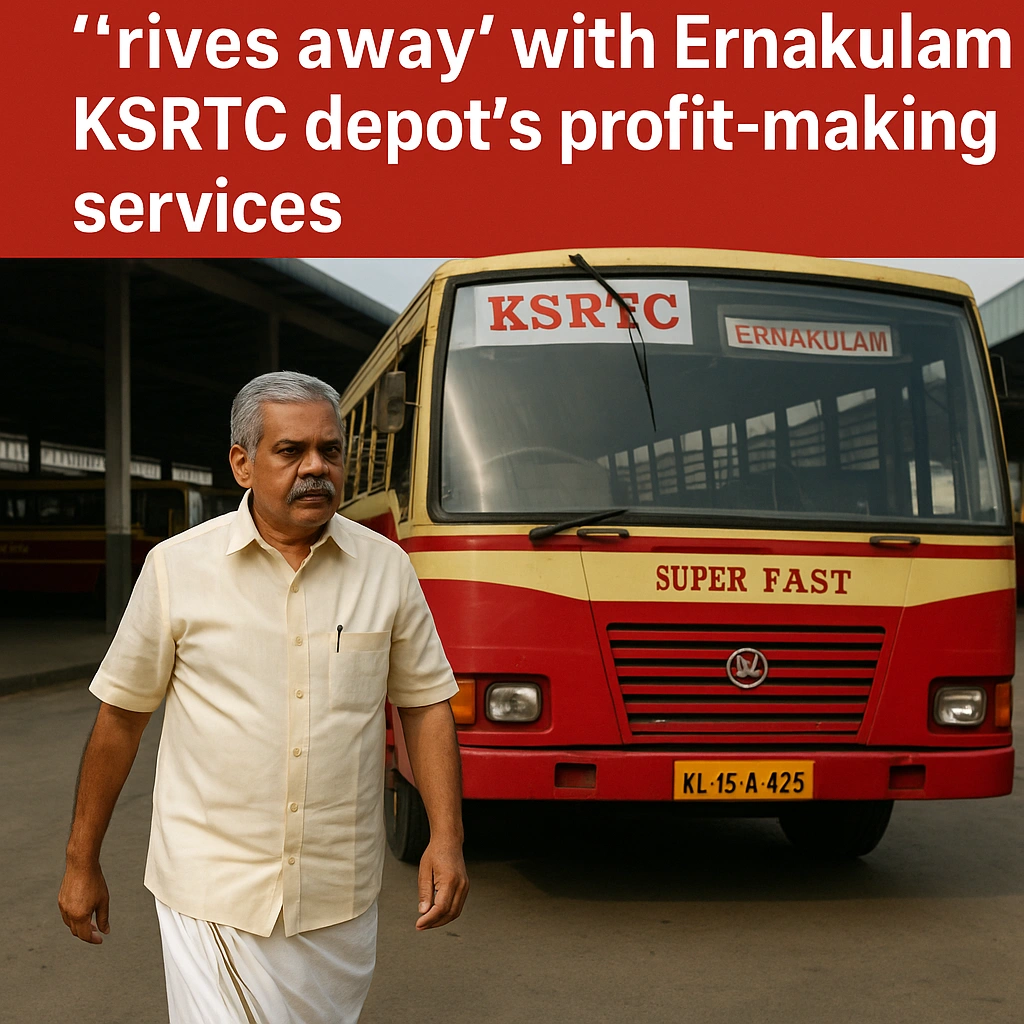
In a move that has left employees and commuters of the Kerala State Road Transport Corporation (KSRTC) in Ernakulam frustrated and shocked, several of the depot’s most profitable services have reportedly been diverted to other depots by direct orders from the Transport Minister. The decision, allegedly made without prior consultation with local stakeholders, has triggered a wave of protests, petitions, and political debates, bringing the state’s transport policies under scrutiny.
This 1500-word report dives deep into the core of the issue — analyzing the motives, implications, and public reaction to the sudden move that many are calling a “strategic sabotage” of one of KSRTC’s top-performing units.
Ernakulam KSRTC Depot: A Rare Profit Generator
In a state where public transport corporations often struggle to break even, the Ernakulam KSRTC depot had emerged as a shining example of what operational efficiency, strategic route planning, and dedicated staff can achieve. In the last fiscal year, it reported record profits, primarily through its inter-district and premium services such as the Super Fast, Garuda, and low-floor AC buses that connect key cities like Trivandrum, Kozhikode, and Bangalore.
According to internal sources, Ernakulam depot managed to clock over ₹1 crore in monthly profit — a significant achievement for a government-run transport system often plagued by losses, rising fuel costs, and staff salary backlogs.
The Shock Shift: Profit-Making Routes Transferred
Things took a sudden turn last month when the Transport Minister, Antony Raju, ordered the relocation of several profit-making services from Ernakulam depot to other KSRTC units in nearby districts, such as Alappuzha and Kottayam. Among the most notable transfers:
-
The Ernakulam–Bangalore Volvo (Garuda) service
-
Ernakulam–Thiruvananthapuram Superfast service
-
Ernakulam–Kozhikode AC low-floor service
These were not just any routes — they were flagship operations, known for high occupancy rates, punctuality, and customer loyalty. Their removal sent shockwaves through the depot.
Employees and Unions Cry Foul
Within hours of the directive, the KSRTC Employees’ Union (AITUC-affiliated) staged a sit-in protest outside the Ernakulam depot.
“Why is a performing unit being punished? This is nothing short of internal sabotage,” said Rajeev Nair, a KSRTC driver with 18 years of service.
Union members allege that the minister’s move is politically motivated, aimed at boosting the performance of less profitable depots in his constituency and neighboring strongholds.
“These services were built brick by brick by the staff of Ernakulam. You can’t just take them away and hand them over like political gifts,” added Latha Kumari, a senior conductor and union leader.
Political Fallout: Opposition Slams “Biased Governance”
The controversy has snowballed into a political slugfest, with opposition leaders from the Congress and BJP accusing the minister of regional bias and poor governance.
VD Satheesan, Leader of the Opposition in Kerala Assembly and MLA from Paravur (Ernakulam), was vocal:
“We will not tolerate this daylight robbery. Ernakulam depot worked hard to become profitable. This arbitrary relocation is an insult to its staff and commuters.”
Even within the ruling Left Democratic Front (LDF), murmurs of discontent have emerged, with local CPI(M) members expressing disappointment over the lack of transparency and consultation.
Commuter Backlash: Service Disruption and Inconvenience
For thousands of daily commuters, the decision has led to increased fares, longer wait times, and confusion over new schedules. Popular routes now originate from distant depots, forcing passengers to travel further and spend more.
“I used to catch the Garuda from Vyttila hub to Bangalore every Friday. Now it starts from Alappuzha. Why should I travel 60 km just to board a bus?” asked Sandeep Menon, a techie working in Bengaluru.
A petition on Change.org demanding the restoration of services to Ernakulam has garnered over 25,000 signatures within a week.
The Minister Responds: “For Better Regional Balance”
In his defense, Transport Minister Antony Raju stated that the reshuffle was necessary to “balance operations” across the state and ensure that “all regions benefit from revenue-generating services.”
“Ernakulam depot has done well, but that does not mean other depots should suffer. We want a more equitable distribution of assets and opportunities,” Raju told reporters.
However, transport experts argue that this logic is flawed.
“Redistribution only makes sense when under-utilized depots have the infrastructure and passenger base to justify it. In this case, it’s like moving gold from a thriving mine to an abandoned pit,” said Dr. Pradeep Kumar, a transport policy analyst at Kerala University.
Transparency Issues: RTI Revelations Stir Controversy
An RTI (Right to Information) filed by activist S. Vinod revealed that there was no formal feasibility study or internal audit conducted before the reallocation. The decision was made via ministerial note, bypassing the KSRTC management board.
This has led to increased calls for a judicial inquiry into the matter, with critics alleging that personal favoritism and backroom lobbying influenced the move.
Historical Context: A Pattern of Political Interference?
This isn’t the first time KSRTC has seen political meddling in operations. Over the years, several profit-making or high-demand services have been tweaked or scrapped due to electoral pressure, internal rivalries, or to prop up lagging depots.
“KSRTC is not a political toy. It’s a public utility,” said Retired CMD Suresh Babu, who ran the corporation during its brief revival phase between 2015-2017. “When decisions ignore data and only chase political optics, this is the result.”
Financial Repercussions: A Profitable Unit Now Bleeding
Initial reports suggest that the Ernakulam depot has already seen a 15% drop in daily collections post-reallocation. Employee morale is down, absenteeism is on the rise, and some conductors have requested transfers.
“Our depot was once a model. Now it’s becoming a shell,” said Depot Manager V.S. Balan, visibly distressed.
The diverted services, meanwhile, have seen mixed results in their new depots — with occupancy dipping and local staff unfamiliar with the route patterns struggling to manage logistics.
What Lies Ahead: Possible Reversals and Protests
Amid mounting pressure, sources indicate that the Transport Department may be considering partial rollbacks or reassignments of certain routes back to Ernakulam.
Union bodies are planning a statewide protest march to the Secretariat in Thiruvananthapuram, demanding immediate action.
Meanwhile, opposition MLAs are preparing to raise the issue in the next Assembly session.
Conclusion: A Lesson in Governance or a Misstep in Policy?
The saga of the Ernakulam KSRTC depot is a case study in how governance decisions, when devoid of transparency, consultation, and data-driven logic, can backfire spectacularly. What should have been a model for scaling success across depots is now a symbol of how internal politics can erode public trust and efficiency.
At a time when Kerala is trying to modernize its public transport system through electric buses, digital ticketing, and smart hubs, such controversies threaten to derail public confidence and institutional integrity.
For the employees of Ernakulam depot and the countless passengers who rely on its services, the question remains: Will sense prevail, or will politics continue to drive the wheel?
Read More: influencers gone wild
FAQs
Q1: Why were the services transferred from Ernakulam depot?
The Transport Minister claimed it was to create regional balance, but critics argue the decision lacked transparency and was politically motivated.
Q2: How has the decision impacted passengers?
Passengers are now facing longer commute times, increased costs, and lack of clarity about the new departure points.
Q3: Is there a chance of the decision being reversed?
Yes, due to rising protests, union pressure, and political backlash, some services might be restored to Ernakulam in the coming months.
Read More: